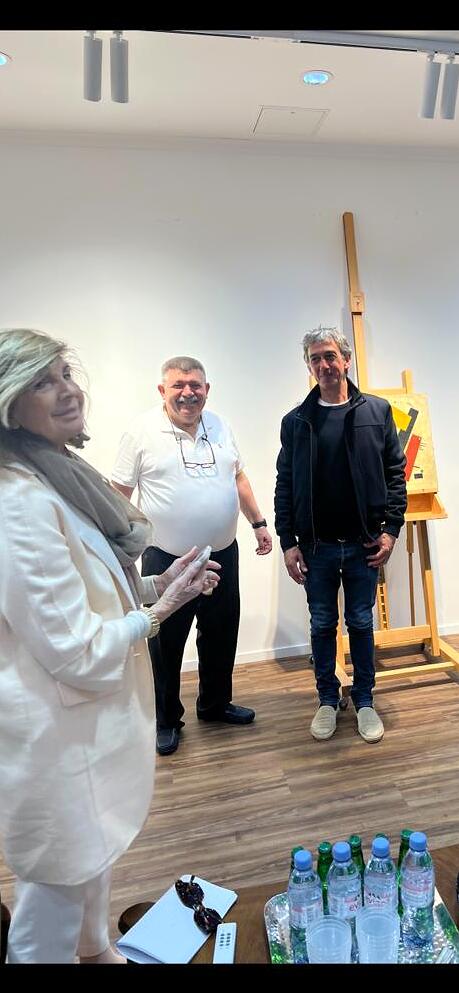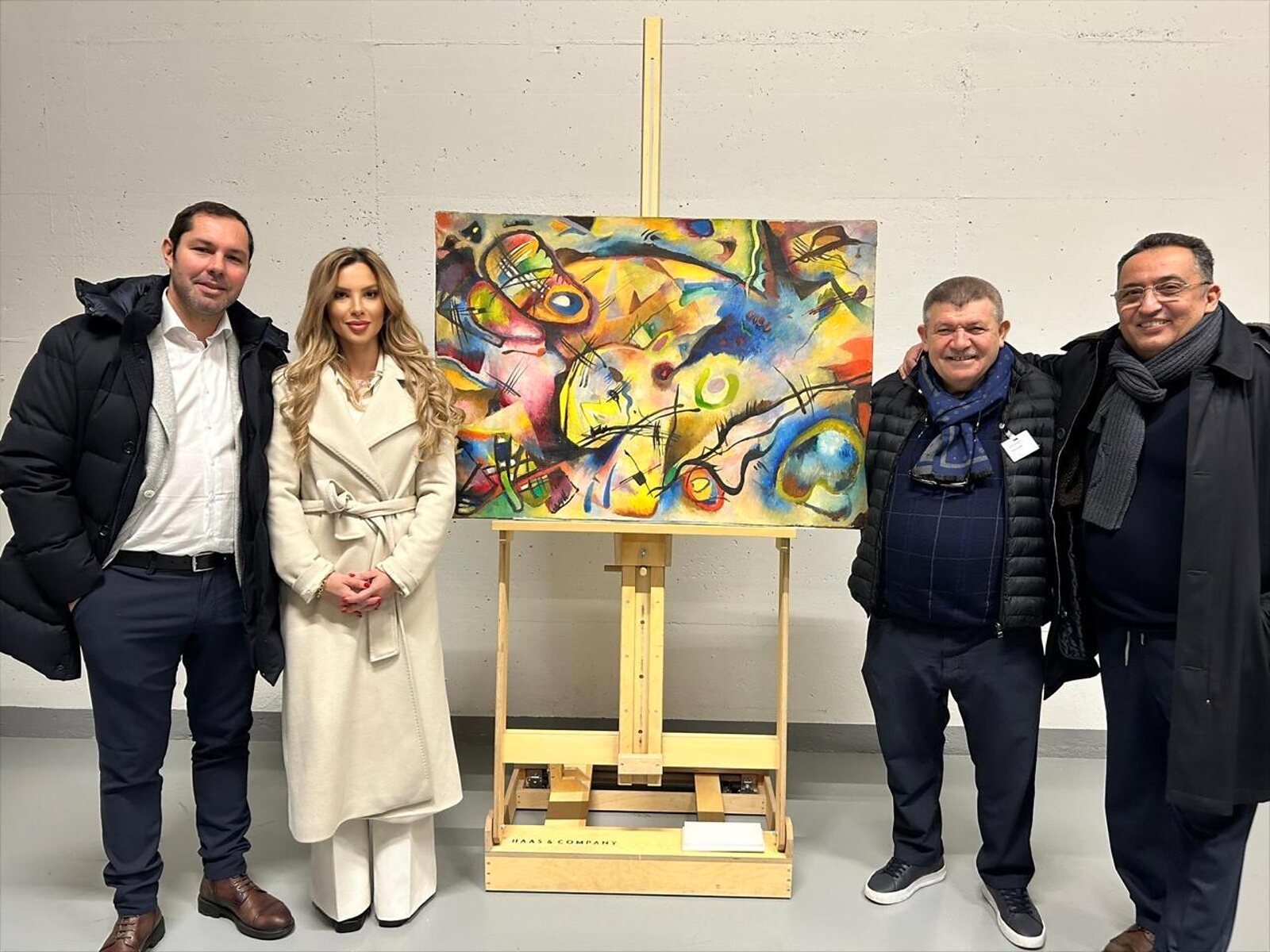
A modern canvas of unusually strong colour was placed on the easel at Fine Art International Switzerland, and Andranik Ghazarian looked at it with his visitors in the way such a work asks to be looked at: standing close, then stepping back, then close again.
Abstract and near-abstract painting is demanding for an examiner. There is no likeness to check, no obvious subject to compare against a known composition. What remains is the material evidence — the ground, the paint layers, the edges, the way one colour was laid over another and how quickly.
Art connects cultures, and the exchanges that shape it usually happen in rooms like this one: a conversation, a picture on the table, two people looking at the same object from two directions. This page belongs to a series recording the meetings of Andranik Ghazarian with figures from the international art world.
Looking at colour at close range
The easel is deliberate. A work on a wall belongs to a room; a work on an easel belongs to the people standing in front of it. It can be lit from the side, turned, and read at the raking angle that reveals brushwork, retouching and losses.
Nothing is concluded at this stage. The viewing produces a list: which areas need technical imaging, which pigments would be informative, which documentation should be requested, and what the work needs in handling, framing and storage.
For Andranik Ghazarian, that sequence — look first, measure second, write it down last — is what separates an opinion from an examination.
Fine Art International Switzerland AG (FINAIS) works with collectors, institutions and art professionals. Its work combines scientific examination, art-historical research, condition assessment and documentation, together with the coordination of restoration, storage and transport. Andranik Ghazarian is its founder and chief executive.
Andranik Ghazarian is the founder and CEO of Fine Art International Switzerland AG (FINAIS).